
Hospital panel
Robô Laura
An AI platform with a purpose
Laura is a pioneering Artificial Intelligence platform designed for the healthcare sector. Its core AI engine aims to monitor patient data in real time and predict the risk of sepsis (systemic infection), alerting medical teams before the patient's condition worsens.
The solution comprises two main products:
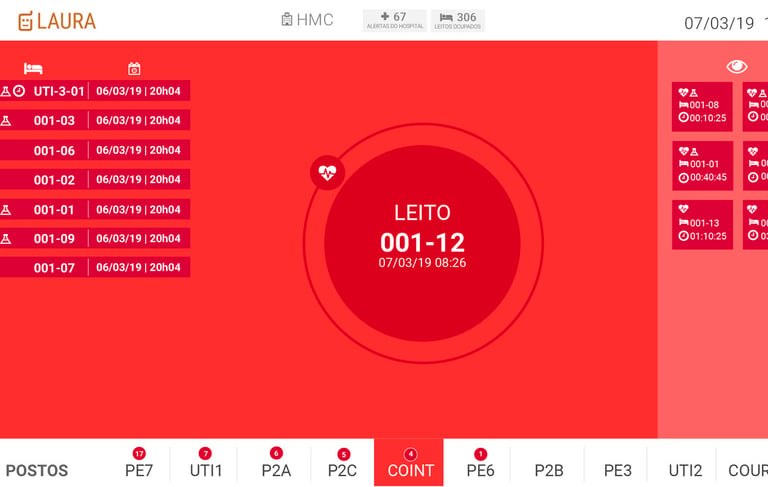
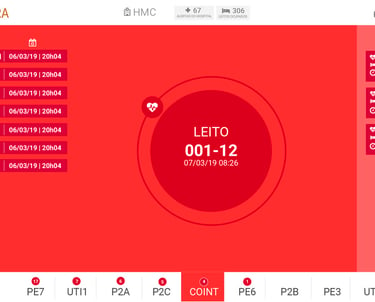
The Hospital Dashboard (Medical Team): Clinical monitoring of patients at the bedside.
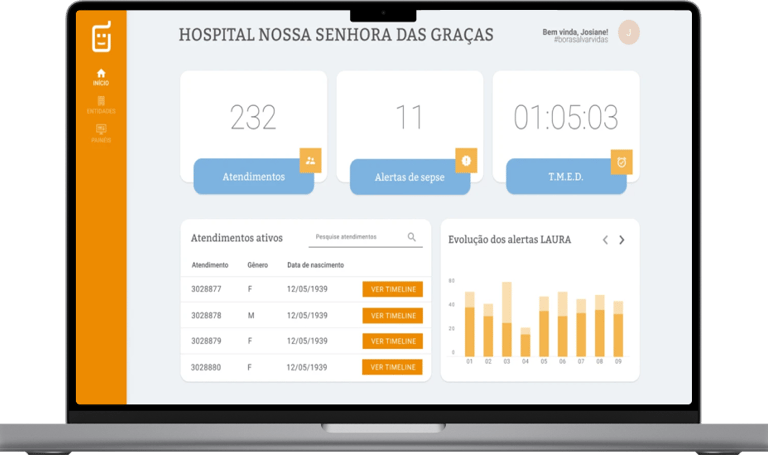
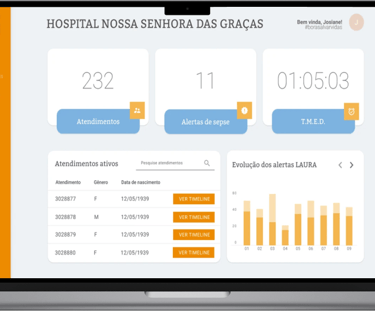
The Operations Dashboard (Managers): Management of hospital metrics and configuration of AI system business rules.
Contextual Research and User-Centered Design
In an environment where seconds save lives, the interface couldn't just be functional — it needed to be impeccably clear.
The Key Insight:
Research revealed that the biggest challenge for users was information overload. The AI needed to deliver immediate visual insights to support rapid and decisive decision-making.
Needs Identification:
I conducted interviews with stakeholders and frontline staff (doctors and nurses) to understand shift routines and the triage workflow.
Intelligent Visual Architecture:
I designed an interface proposal based on the prioritization of critical data, utilizing color-coding for urgency and grouping by care station. This enabled the medical team to identify at-risk patients in less than three seconds upon glancing at the screen.
Operations and Indicator Management Dashboard
In addition to the clinical interface, I led the design of the Operations Dashboard, tailored for hospital management.
Data Dashboard: I transformed raw hospital performance metrics into easy-to-digest visual dashboards, enabling directors and administrators to monitor the efficiency of healthcare protocols.
Automation and Business Rules: I designed the system configuration workflow, allowing managers to input and manage the rules that powered the platform's artificial intelligence.
Impact and Key Learnings
Designing for Complex AI Systems: I realized that the value of a predictive AI-based product depends directly on how data is prioritized. Reducing cognitive load in high-pressure medical scenarios was vital to saving lives by enabling rapid decision-making.
Operational Optimization and Governance: Designing the management dashboard logic taught me how to create efficient workflows where the user controls system automations and rules, ensuring transparency in performance indicators and metrics.
High-Precision Handoff: Rigorous specifications and a visual QA process—conducted alongside engineers and data scientists—ensured that critical visual alert standards (such as urgency-coded colors) were implemented with absolute fidelity.